Ownership costs, South Africa
What It Really Costs to Own a Yacht in South Africa
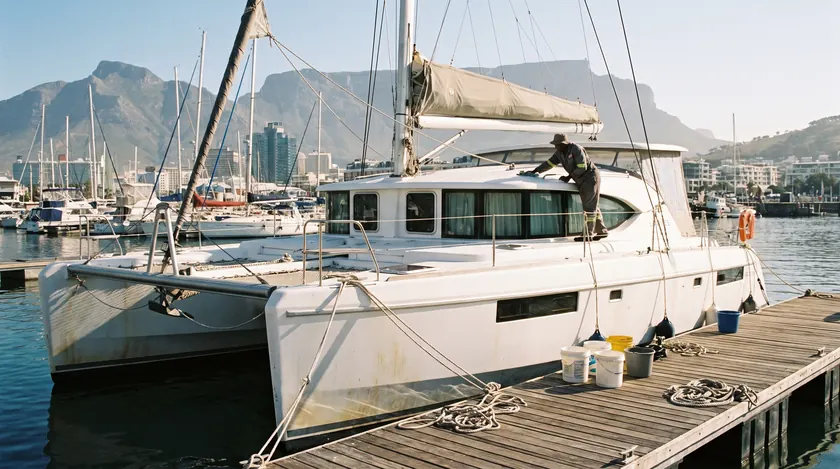
We get the same call every month. A client has found the boat and wants to know what it actually costs to keep it. The purchase price is the number everyone quotes first. The number that matters more, berth fees, haul-out, duty if the boat came from outside the country, rarely gets written down before the sale closes.
This guide sets out the real cost stack for owning a yacht in South Africa in 2026: what marinas from Cape Town to Knysna actually charge, what a haul-out and antifoul cycle costs, and what SARS collects if the boat was not built here. Figures below come from SAMSA, SARS and the marina and brokerage numbers we track model by model. Where a rate is not published, we say so and name who to ask directly.
How much does it cost to keep a yacht in Cape Town, Durban or Knysna?
Location changes the number more than almost anything else. A berth at one of Cape Town's major marinas runs broadly $500 to $2,000 a month, and that range is wide because pricing is often set by beam rather than length alone, a detail that matters a great deal if you are looking at a catamaran instead of a monohull. Durban's marina and Point Yacht Club sit in roughly the same band, though the club does not publish a rate card, so confirm direct before you budget against it.
Knysna is the outlier. A swing mooring at Knysna Yacht Club has been reported around R7,500 a year plus about R3,000 a year in club membership, a fraction of a Cape Town berth, though that figure is forum-sourced and worth confirming before you rely on it. The tradeoff is Knysna's shallow, tide-dependent entrance, known locally as the Heads, a real constraint if your boat draws much water.
The table below lines up what we know against what still needs a phone call to the marina in question.
| Location | Facility | Typical cost | Note |
|---|---|---|---|
| Cape Town | Major marinas, e.g. V&A Waterfront Marina | $500-$2,000/month | Often priced on beam, not just length; 12 visitor berths plus the Quay 7 superyacht project due around October 2026 |
| Durban | Durban Marina / Point Yacht Club | Broadly Cape Town-level, confirm direct | Restaurant on site, temporary memberships for visiting sailors |
| Knysna | Knysna Yacht Club swing mooring | Around R7,500/year plus R3,000/year club membership (forum-sourced, verify current rate) | Shallow, tide-dependent Heads entrance limits deeper-draft boats |
What do marina and mooring fees in South Africa actually cover?
A Cape Town berth buys more than a length of pontoon. The V&A Waterfront Marina has 12 visitor berths inside the working harbour, with fuel, WiFi, chandlery and laundry on site, and it sits right next to Robinson Dry Dock and the Syncrolift, so routine haul-out is a short tow rather than a passage. Royal Cape Yacht Club, one of the country's oldest clubs and host of the Cape to Rio race, adds an on-site chandlery and repair yard of its own.
The Waterfront is also building the Quay 7 Superyacht Marina, an investment of roughly R230 million, about US$13.5 million, adding 8 berths for vessels between 30 and 90 metres, 6 stern-to and 2 beam-on, targeted for completion around October 2026. It is designed to double as commissioning and export staging for local catamaran builders in the off-season, which tells you how tightly Cape Town's boatbuilding and berthing infrastructure are already wired together.
None of this is charity. You are paying for security, services, and increasingly, proximity to a working refit industry that most other African markets simply do not have yet.
What does haul-out and antifouling cost?
This is the line item first-time owners underbudget most often. One forum-sourced example put a three-year antifouling and haul-out cycle at around R10,000, a useful anchor point, not a quote. Ask your yard for a written estimate against your boat's actual length and beam before you assume that figure applies to you.
Yachtport SA, based at Saldanha and Cape Town, is described as the region's only 100-ton travel-lift facility with an indoor repair workshop, and it is the core haul-out node feeding the wider Cape Town marine cluster. If your boat is a catamaran, budget above what a same-length monohull would pay. Cats routinely draw a berth or haul-out surcharge priced on beam, and both the Leopard 45 and Leopard 50 carry meaningfully more beam than a monohull of comparable length. A twin-diesel catamaran also means two engines to service on the same haul-out visit, not one, though Yanmar diesels on both models keep that routine servicing straightforward at any yard in this cluster.
For the ongoing running-cost picture beyond haul-out alone, see our import guide for South Africa and Nigeria for how a duty bill on top of these numbers can change the total.
What import duty and VAT applies if the boat wasn't bought locally?
If your yacht was built in the EU or the SADC region, long-standing practice is that it clears customs duty-free, though VAT is still due. Anything built elsewhere pays 10 percent customs duty on top of VAT. VAT itself sits at South Africa's standard 15 percent rate, and it is worth flagging that some older articles still quote 14 percent, the pre-2018 rate, so always check the current SARS figure rather than trust an old blog post.
There is a genuine grey area for foreign yachts arriving on passage. Most clear in on a DA1 or DA3 as a foreign yacht in transit, and in practice this is not charged an import-clearance deposit, even though the Customs Act technically allows for one on temporary imports. Treat that as a confirm-with-SARS item for your specific itinerary, not a guarantee, and get the current HS 8903 classification and rate checked by a customs broker before you rely on any of this for a real purchase decision.
Have the boat picked? Send the model, length and beam, where it was built and the berth you want, and we fill the cost table for it.
Ask a questionIs a locally built Leopard catamaran cheaper to own than an imported boat?
Often, yes, and the saving starts before the boat ever touches water. Robertson & Caine builds the Leopard range at its Cape Town factory, the Southern Hemisphere's largest catamaran builder and, by its own count, the world's third largest, which completed its 3,000th hull in April 2025 and built roughly 200 of the near 300 boats made in South Africa in 2024, per Engineering News. A South African buyer ordering a Leopard 45 factory-direct sidesteps import duty entirely and gets easier access to factory parts and warranty support than any imported European brand carries.
A used Leopard 45 currently runs roughly $500,000 to $800,000 depending on age, hours and charter history, as of the 2026 market range we track. Set that against an imported monohull like the Beneteau Oceanis 46.1, priced roughly $250,000 to $659,000 used. The Beneteau avoids the catamaran beam surcharge on mooring and haul-out, but a boat sourced from outside South Africa still carries whatever duty and VAT applies on the way in.
The table below is not a verdict, ownership cost depends on your cruising plans as much as your boat, but it shows where the two ends of that decision actually sit.
| Factor | Leopard 45, Cape Town factory-direct | Imported monohull, e.g. Beneteau Oceanis 46.1 |
|---|---|---|
| Used price range, 2026 | $500,000-$800,000 | $250,000-$659,000 |
| Import duty exposure | None for a South African buyer ordering direct | 10% if non-EU/SADC origin, duty-free if EU/SADC, VAT still applies either way |
| Marina and haul-out fee basis | Often priced on beam, expect a premium | Usually priced on length, typically the cheaper basis |
| Parts and warranty access | Direct factory support in Cape Town | Depends on the local dealer network for that brand |
The annual cost stack, line by line
Put the lines above in one place and the shape of a South African ownership year appears, even where a figure still has to be confirmed. The table uses only the numbers already on this page, and names the party who confirms each line for your boat.
| Line item | What is known | Confirm with |
|---|---|---|
| Berth, Cape Town or Durban | $500 to $2,000 a month at the major marinas; catamarans often priced on beam | The marina's current rate card |
| Mooring, Knysna | Around R7,500 a year for a swing mooring plus about R3,000 club membership (forum-sourced) | Knysna Yacht Club |
| Haul-out and antifouling | One forum example: about R10,000 for a three-year cycle; cats pay a beam surcharge | Yachtport SA or your yard, against your length and beam |
| Import duty | 0% for EU or SADC-built boats, 10% for other origins | SARS or a customs broker, HS 8903 |
| VAT on import | 15%, the current rate; ignore sources still quoting 14% | SARS |
| Engine servicing | Two diesels on a catamaran, one on a monohull; Yanmar on the Leopard 45 and 50 | The yard, per engine hours |
| Insurance | Priced on hull value, cruising area and crew experience; no public rate card | A South African marine insurer, per boat |
| Crew and management | Agents around the Waterfront and Royal Cape Yacht Club quote per boat | Del Shipping & Trading or Cape Town Yacht Services |
What to send for a line-by-line estimate
Model and year, length and beam, where the boat was built, the flag it carries now, and the berth you intend to use. With those five we fill the table for your boat and send it back as one annual number with the assumptions listed. Start from the boats we track at yachts for sale in South Africa and catamarans for sale in South Africa, or from the Leopard 45 and Leopard 50 pages if the comparison is factory-direct against imported.
Building your own ownership number
Every figure above needs checking against your actual boat before it becomes a budget. Brokers active in the Cape Town market, among them Yacht and Power Sales, Boating World, Boatshed South Africa and Boat Brokers, can quote current berth waiting lists and haul-out slots, and a customs broker can give you an exact duty and VAT figure instead of a range.
If you want that number built out line by line for a specific boat, send us the model and your intended berth. We do this calculation for yachts for sale in South Africa every week, and the same math applies whether you are comparing a Leopard 45 against a monohull or weighing a factory-direct order against something already sitting on the water. We run this same breakdown for our current listings across Africa before quoting any buyer a total cost, not just a purchase price.
Your questions, answered
How much does it cost to keep a yacht in Cape Town vs Durban vs Knysna?
Cape Town and Durban both run broadly $500 to $2,000 a month for a marina berth, with beam often driving the price as much as length. Knysna is far cheaper, a swing mooring at Knysna Yacht Club has been quoted around R7,500 a year plus roughly R3,000 a year in club membership, though that figure is forum-sourced and worth confirming. Knysna's shallow, tide-dependent Heads entrance is a real tradeoff for deeper-draft boats.
What are typical marina and mooring fees in South Africa?
Fees vary by facility and by whether pricing is set on length or beam. The V&A Waterfront in Cape Town offers 12 visitor berths with fuel, WiFi and chandlery on site, and is adding the Quay 7 Superyacht Marina, 8 berths for 30 to 90 metre vessels, targeted for around October 2026. Confirm current rates directly with each marina since none of the facilities in this guide publish a public rate card.
What does haul-out and antifouling cost?
One forum-sourced figure put a three-year antifouling and haul-out cycle at around R10,000, a useful anchor point rather than a quote. Yachtport SA at Saldanha and Cape Town runs the region's only 100-ton travel lift with an indoor workshop, and catamaran owners should budget above monohull rates since many yards price haul-out on beam.
What import duty and VAT applies if the boat wasn't bought locally?
Boats of EU or SADC origin clear duty-free but still owe VAT at South Africa's standard 15 percent rate. Boats from elsewhere pay 10 percent customs duty on top of that VAT. Always confirm the current SARS rate and the HS 8903 classification with a customs broker, since some published guidance still quotes the pre-2018 14 percent VAT rate.
Is a locally built Leopard catamaran cheaper to own than an imported boat?
Usually, yes, for a South African buyer. Ordering a Leopard direct from Robertson & Caine's Cape Town factory sidesteps import duty entirely and gives easier access to factory parts and warranty support than an imported brand carries. A used Leopard 45 runs roughly $500,000 to $800,000 in the 2026 market range, against $250,000 to $659,000 for an imported monohull like the Beneteau Oceanis 46.1, though the Beneteau avoids the catamaran beam surcharge on berthing and haul-out.
Need a yearly cost estimate for your boat?
Send the model and your intended berth, and we will build the annual cost with you, line by line.
Ask a question